Tuesday, September 30, 2008
The Most Advanced Quadruped Robot on Earth
BigDog is the alpha male of the Boston Dynamics family of robots. It is a quadruped robot that walks, runs, and climbs on rough terrain and carries heavy loads. BigDog is powered by a gasoline engine that drives a hydraulic actuation system. BigDog's legs are articulated like an animal’s, and have compliant elements that absorb shock and recycle energy from one step to the next. BigDog is the size of a large dog or small mule, measuring 1 meter long, 0.7 meters tall and 75 kg weight.

Saturday, September 27, 2008
Mapping out the Neural Networks
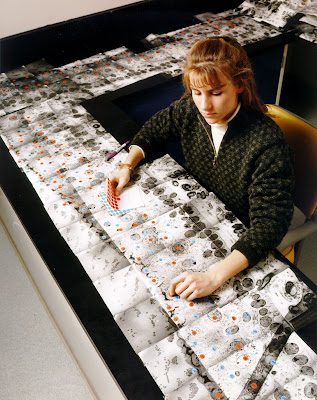
Mapping out the neural networks of the inner ear as part of Dr. Murial Ross's study of the effects of space travel at the NASA Ames Research Center, Mountain View, California.
Project Mercury Altitude Wind Tunnel Gimbaling Rig

MASTIF - Multiple Axis Space Test Inertia Facility - was developed for Project Mercury to train astronauts in gaining control over a spacecraft that could move in multiple directions at once--pitching, rolling and yawing all at the same time. This photo is similar to photo GPN-2000-001186, but not identical.
Manned Manuevering Unit

Mission Specialist Bruce McCandless II ventured further away from the confines and safety of his ship than any previous astronaut ever has. This space first was made possible by the Manned Manuevering Unit or MMU, a nitrogen jet propelled backpack. After a series of test maneuvers inside and above Challenger's payload bay, McCandless went "free-flying" to a distance of 320 feet away from the Orbiter. The MMU is controled by joy sticks positioned at the end of the arm rests. Moving the joy sticks left or right or by pulling them fires nitrogen jet thrusters propelling McCandless in any direction he chooses. A still camera is mounted on the upper right portion of the MMU. This stunning view shows McCandless with the MMU out there amongst the black and blue of Earth and space.
Iron Cross Attitude Simulator With Pilot
 NACA High-Speed Flight Station test pilot Stan Butchart flying the Iron Cross, the mechanical reaction control simulator. High-pressure nitrogen gas expended selectively by the pilot through the small reaction control thrusters maneuvered the Iron Cross through the three axes. The exhaust plume can be seen from the aft thruster. The tanks containing the gas can be seen on the cart at the base of the pivot point of the Iron Cross. NACA technicians built the iron-frame simulator, which matched the inertia ratios of the Bell X-1B airplane, installing six jet nozzles to control the movement about the three axes of pitch, roll, and yaw.
Launch Phase Simulator at Goddard Space Flight Center

Goddard's Launch Phase Simulator or High-Capacity Centrifuge simulates vibration, G-forces and changing pressures that a spacecraft would encounter during launch and landing. To perform a test, which typically lasts one day, technicians place spacecraft components and even entire satellites in either the simulator's cylindrical test chamber (at the far left in this photo) or on its test platform at the other end (it was not installed when this photo was taken). Powered by two 1,250- horsepower motors, the facility then spins at up to 38.3 revolutions per minute to simulate a 30-g environment. (Most people experience about 2-g when they ride on a roller coaster.) Engineers monitor test results from an adjacent control room.

Subscribe to:
Posts (Atom)