Showing posts with label vestibular sense. Show all posts

Wednesday, November 19, 2008

Balance Substitution


Researchers at Oregon Health & Science University's Neurological Sciences Institute and the University of Bologna have developed a portable "Ipod-like" device that can be used to help correct balance disorders. Scientists believe this new device, based on auditory feedback of balance, can be worn on the belt like a pager to provide regular therapy for patients with balance disorders, improving their day-to-day activities. The research is published in the current edition of the Archives of Physical Medicine and Rehabilitation.

http://www.ohsu.edu/landing/balance/

Saturday, September 27, 2008

Mapping out the Neural Networks


Mapping out the neural networks of the inner ear as part of Dr. Murial Ross's study of the effects of space travel at the NASA Ames Research Center, Mountain View, California.

Sunday, April 13, 2008

Vertical Oscillating Platform


The Graybiel Lab constructed a vertical oscillating platform for a specific series of motion sickness experiments. The design was conceived by Dr. Simone Bortolami who also directed the construction. The platform can move up and down ± 0.85 meters at a frequency of 0.25 Hz, one complete cycle in 5 sec. This is the key frequency produced by large ships that evoke motion sickness. With this intensity of stimulation, it has been found that 50% of subjects will vomit in one hour (O’Hanlon & McCauley, 1974).

The moving shuttle rides on linear bearing rails and is driven by a 2 meter long ball screw and high torque motor. The system was designed with a minimum safety factor of 4 on the weakest link (the ball screw to gearbox coupling) under the highest load conditions. An independent braking system is triggered by three automatic failure modes (one software and two hardware) and kill switches are accessible to the subject and experimenter. Both hardware safety loops were designed to OSHA standards.

The seat in which the subject rides is built for racing cars and cushions the subject in the unlikely event of shock. It has a five-point safety harness designed to withstand a 9g crash load. The highest g load under operational conditions will be just under 2g, at the point where the oscillator reverses from down to up motion.

Saturday, April 12, 2008

DIY: Vestibular illusions

Illusion 1 – Sensing Yaw Motion

What to Do
The volunteer sits on the chair with head upright and fists on his or her thighs in the “two thumbs up” position. Tell them to rotate their wrists so that the thumbs point in the direction of movement. If the movement changes to a different direction, the wrists should be rotated so that the thumbs point in that direction. If the volunteer does not perceive any motion, the thumbs should be pointed upwards. Cover the volunteer’s eyes with the blindfold and touching only the seatback of the chair, give the chair a spin. Push the chair hard enough to rotate it eight to ten times. If necessary, give the chair an additional gentle push to keep it rotating. Gripping the chair back, slow the chair to a rapid but smooth stop. Wait a few moments to observe thumb movements and then remove the blindfold. Tell the volunteer to stare at a fixed point on the wall.

What Happens
At first, the volunteer will point thumbs in the same direction the chair is rotating. After stopping the chair, the volunteer will reverse the direction of the thumbs, indicating a feeling of movement in the opposite direction. Upon opening his or her eyes, the volunteer will experience rapid side-to-side flicking motions of the eyes that can be observed by staring directly at the volunteer’s face.

Graphic depicting a test subject indicatings the perceived direction of movement by pointing his or her thumbs.

Why
The rotation of the chair causes the endolymph within the yaw axis semicircular canal to begin moving. At first, the inertia of the fluid causes it to lag behind the motion of the subject’s body. This causes the cupula and its hair cells to bend. Now stimulated, the hair cells send signals to the brain telling it that motion has been initiated and in what speed and direction. When the chair is stopped, the momentum of the now moving endolymph causes it to continue moving even though the volunteer’s head and semicircular canals have stopped. The hair cells are now bent in the exact opposite direction as before. This sends a false signal to the brain that the direction of motion has reversed. Nystagmus, an involuntary flicking eye movement, shows the link between the vestibular and visual systems. This reflex occurs when the brain mistakenly believes the body is still moving in this Illusion and instructs the eyes to “look ahead”. The eyes track objects that the brain believes are coming into the field of vision even though the view isn’t changing.

Above: The test subject indicates the perceived direction of movement by pointing his or her thumbs.

Safety Precautions

• The Barany Chair is not an amusement ride. Please follow the directions and exercise caution when it is being used.
• Use the safety lap belt and a spotter at all times.

• Assist students in getting in and out of the chair. A small step stool may be helpful.

• Following demonstrations, allow students to sit in a non-rotating chair until any dizziness wears off.

• Perform only one illusion at a time. Allow a few minutes for the effects of the first illusion to wear off before beginning another.

• Screen candidates for motion sickness, but keep a plastic bag or container nearby in the event of illness.

Vestibular Illusion 2 – Failure to Sense Motion

What to Do
Follow the same set-up used for Illusion 1. Put a dark blindfold on the volunteer and provide ear protection to diminish auditory clues. Rotate the chair as before and have the volunteer identify the direction of motion with their thumbs. Keep the chair spinning 10 or 15 times before very gently stopping it. As with the first illusion, the volunteer should point his or her thumbs in the direction of perceived movement or upward if the volunteer perceives that motion has stopped.

What Happens
The volunteer will perceive the start of motion by pointing his or her thumbs in the direction of rotation. After a number of rotations, the
volunteer will point the thumbs upward even though the chair is still rotating. Finally, the volunteer will point thumbs the opposite direction
from the first movement to indicate counter rotation.

Why
As with the first illusion, endolymph in the yaw semicircular canal will lag behind the initial motion. Signals sent to the brain will be interpreted as bodily rotation in a particular direction. Gradually, the endolymph in the yaw semicircular canal will catch up with the motion, and stimulation of the hair cells in this canal will stop. The brain will falsely interpret the lack of hair cell stimulation to mean that the chair has come to rest. Later, when the chair slows down or stops, the momentum of endolymph will cause it to continue to flow through the yaw canal. Stimulation in the opposite direction will be falsely interpreted as movement in the opposite direction.

Vestibular Illusion 3 – Sensing Roll Motion

What to Do
Have the volunteer grip the arm rests with both hands. After putting the blindfold in place, instruct the volunteer to drop his or her chin to the chest and close the eyes. Spin the chair at least ten times then bring it to a smooth stop. Tell the
volunteer to sit up straight and open their eyes. Safety Reminder: Be sure to use a spotter when performing this illusion.

What Happens
The volunteer will experience a powerful cartwheeling sensation to the left or right (depending upon the spin direction) upon opening his or her eyes. The volunteer will find it difficult to remain sitting straight up and will tend to lean aggressively to one side or the other.

Why
By tilting the head forward, the roll axis
semicircular canal will be brought into the same plane of rotation as the Barany Chair. By stopping the chair and tilting the head back to the vertical position, the roll axis will be repositioned while the endolymph fluid is still moving in the roll axis canal. This will cause a strong sensation of cartwheeling movement. The volunteer will try to lean in the opposite direction to compensate for the effect.

Vestibular Illusion 4 – Sensing Pitch Motion

What to Do
Have the volunteer grip the arm rests with both hands. Instruct the subject to close their eyes, lean forward slightly, and turn their head as far to one side as possible. Spin the chair at least eight times in the direction the volunteer is facing, then bring it to a smooth stop. Tell the volunteer to sit back and raise his or her head to the upright position and open their eyes. Safety Reminder: Do not use a blindfold or ear covers when performing Illusion 4. Be sure to use a spotter when performing this illusion.

What Happens
The volunteer will sense that he or she is tumbling backwards and may have a difficult time sitting up.

Why
By leaning forward and tilting the head to the side, the pitch axis semicircular canal will be brought into the same plane of rotation as the motion of the Barany Chair. After stopping and returning to the upright position, endolymph fluid will continue to move in the pitch axis canal. This will cause a strong sensation of tumbling. The volunteer will readjust his or her body position in order to counteract the perceived movement.

Important Safety Note: While it is possible to simultaneously stimulate all three semicircular canals with the Barany Chair, it is NOT recommended. Simultaneous stimulation of the three canals can lead to total spatial disorientation sensation and illness.

Other Uses for the Barany Chair

The classroom version of the Barany Chair is ideal for a variety of other demonstrations of physics and technological challenges.

Conserving Angular Momentum – Hand the volunteer small barbells to extend at arm’s length during the initial rotation. By bringing the barbells in toward the chest, the rotation rate will increase. The rotation rate increases because the barbells are traveling in a smaller circle than before. To conserve their angular momentum, the rotation rate has to increase. Extending the barbells back outward slows the rotation rate, but angular momentum is still conserved. This demonstration gives the illusion of getting something for nothing.

Newton’s Laws of Motion – Hand the volunteer an electric leaf blower. While preventing the cord from wrapping too tightly around the pedestal, have the student turn on the blower and direct the exhaust at right angles. The chair will begin to accelerate. After a few rotations, the exhaust should be directed the other way so that the chair decelerates. The rotational movement of the chair demonstrates Newton’s First and Third Laws of Motion. The rate at which the chair accelerates or decelerates demonstrates the Second Law of Motion.

Working In Space – Firmly hold a threaded pipe joint over the head of the volunteer. Have the volunteer screw a pipe nipple tightly into the joint. The chair simulates microgravity and Newton’s Third Law of Motion comes into play. Without a fixed anchor point, the astronaut rotates in the opposite direction from the turning motion. This demonstration illustrates why space-walking astronauts require foot restraints as they work in space.

NASA learning resources

Monday, February 25, 2008

Barany chair

The Bárány chair, named for the Austrian physiologist Robert Bárány, is a device used for aerospace physiology training, particularly for student pilots. The subject is placed in the chair, blindfolded, then spun rapidly about the vertical axis while keeping his head upright or tilted forward or to the side. The subject is then asked to perform tasks such as determine his direction of rotation while blindfolded, or rapidly change the orientation of his head, or attempt to point at a stationary object without blindfold after the chair is stopped. The chair is used to demonstrate spatial disorientation effects, proving that the vestibular system is not to be trusted in flight. Pilots are taught that they should instead rely on their flight instruments.

Monday, January 14, 2008

Three sources of balancing information

Three sources of balancing information.
The first source is proprioceptive sensors in our muscles that tell our brains where the parts of our bodies are in relationship to each other. The second source is the tiny hairs in our inner ears called cilia, the vestibular system, that tells us how our heads are positioned. The third source, and probably the most important, is our eyes. Eyes tell us which way is up and which way is down.

Spinning chair and balancing platform.
The spinning chair is called a centrifuge. The balancing platform is known as the "balance booth" but is actually a "posturography system."

http://liftoff.msfc.nasa.gov/news/2003/news-balance.asp

Wednesday, January 2, 2008

Physiology of Vomiting

How does a person vomit?

A. The stomach is relatively unimportant in the act of vomiting. The brain is in charge, and muscles adjacent to the stomach do the work. The vomiting center is located in the medulla oblongata, the rear part of the brain. This neural center acts on information supplied by the stomach, the intestines, the gag reflex in the throat, the inner ear, and most importantly, the chemoreceptor trigger zone (CTZ), which is located on the floor of the fourth ventricle in the brain, in case anyone cares. The CTZ takes in data about the presence of toxins in the blood and alerts the vomiting center to go to work when it believes the body has been poisoned. The stomach and intestines can signal for vomiting to occur when they are irritated or overloaded. The function of the gag reflex in the throat -- actually the province of something called the constrictor muscle-- is well known.

The second phase of the vomiting cycle is retching. The contractions of retching feel much like those of the expulsion phase, but retching too does not lead inevitably to vomiting. The vomiting cycle thus can be halted at any point prior to expulsion. In retching, the respiratory and abdominal muscles contract, forcing the gastric contents into the esophagus, but this is not enough to propel them out of the body. At the rest phases between retches, the stomach contents reflux back into the stomach.5

The key distinction between retching and expulsion is the motion of the diaphragm. When vomiting occurs, it is because the diaphragm relaxed suddenly during the retching cycle, enabling the stomach contents to be expelled through the mouth.6

The muscles that do the work are the diaphragm and the abdominal muscles. When the body is ready to vomit, the pyloric sphincter (which separates the stomach from the duodenum) closes, while about 45 seconds before vomiting,7 the lower esophageal sphincter (which separates the stomach from the esophagus) relaxes greatly, pulling the top of the stomach into the shape of an inverted funnel. The stomach contracts to shift contents from the lower to the upper portion.8 The abdominal muscles tighten, and the diaphragm goes down sharply in one or more contractions, squeezing the stomach. With the usual exit from the stomach closed, the contents have nowhere to go but up.

Q. Where exactly is the constrictor muscle?

A. The constrictor muscle is in the back of the throat, right behind the uvula.


Q. Why does vomit taste so awful?

A. It's a myth that stomach acid gives vomit its bad taste. Stomach acid is tasteless, although it does produce a burning sensation if it comes into the mouth through burping, vomiting, or acid reflux. The foul taste of vomit is due to three factors:

  1. Vomit contains butyl acid, a chemical produced in the small intestine, which gives vomit its unforgettable smell and taste
  2. Vomit consists of digested and partly-digested food -- different kinds of food -- mixed together in ways that no one would ever attempt voluntarily
  3. Vomit typically contains no sweeteners; sugars are the first part of food digested, as digestion of them actually begins while they're still in the mouth

Q. Why does vomit look like nothing that has been eaten?

A. Only vomiting occurring shortly after eating would contain anything looking familiar. By the time the stomach contents have been processed by the small intestine, they become unrecognizable glop.

Q. Why is there material from the small intestine in vomit?

A. As mentioned above, stomach acid is very strong. One of the main functions of the stomach is to disinfect that which is entering the body, and it uses a powerful level of hydrochloric acid to soak the food sterile. Ask any heartburn sufferer about the power of stomach acid. In an important step approaching the climax of the vomiting process, the vomiting center issues a command to have the small intestine send a fair portion of its contents back into the stomach. This starts about one minute before vomiting and lasts about 45 seconds.9 (For those who cherish bits of trivia, this is called the retrograde great contraction.) This has the effect of neutralizing the vomit,10 making it less damaging to the esophagus, throat, mouth, and teeth. Some researchers contend that expulsion of the intestinal content is a necessary part of the vomiting act in itself [since the intestine is where the toxin was detected by the CTZ], and that the movement into the stomach puts it in place for being ejected.11 The transfer of intestinal matter also increases the volume in the stomach, which makes vomiting easier.

Q. Increased volume makes vomiting easier?

A. Absolutely. For those who suffer from multiple episodes of vomiting, those later incidents would be soothed greatly if there were material available to be brought up. People who suffer from the "dry heaves" at the end of a vomiting cycle describe them as much more painful and traumatic than the "wet heaves" that open the process. In fact, dry heaves can even damage the esophagus and sphincter, causing bleeding and even tearing.

Q. How should one vomit?

A. Every medical book that has an opinion says that the head should be kept lower than the hips while vomiting. This is to prevent aspiration of the vomit into the lungs. This is especially important while holding a small child who may not know what to do.

In practical terms, this means that one should stand upright and bend over so that the mouth is almost in the toilet. Children should be taught to vomit this way. Anecdotal evidence suggests that most people disregard this advice and either kneel or squat in front of the toilet, positions which do nothing to protect one's airway.

Despite the common sense of it, it makes no difference in terms of efficiency what position the body is in. Medical researchers trying to learn the best way to remove poisons from the body in emergency treatment experimented with people vomiting in the two positions and found that vomiting while lying prone as opposed to sitting made no difference in the volume of material ejected.12

Q. How did those researchers find 20 people who were willing to be induced to vomit in two different positions?

A. Beats me, but you may be interested to know those 20 subjects vomited an average of 660 ml while sitting and 636 ml while horizontal.13

FACTOID: In a recent Internet survey, 64 percent reported having vomited in public.

Q. How is vomiting induced?

A. The two main ways are stimulation of the constrictor with a finger -- bet you knew that -- and ingestion of syrup of ipecac, which has been the emetic of choice for decades now. In the past, people were urged to induce vomiting using a greater variety of emetics, including salt and mustard powder, which are not as effective as ipecac and which can be poisonous themselves if vomiting does not occur. It's a good idea to keep syrup of ipecac on hand in case the poison center ever tells you to administer it to a poisoning victim. The stuff is available over the counter at any drug store.

Q. But isn't ipecac dangerous too?

A. Only if it's abused, as by a bulimic using it regularly. Syrup of ipecac is quite safe in emergency administration, partly because the recommended dose -- 30 ml (2 tbsp) -- will cause vomiting in upwards of 99 percent of patients. In fact, as little as 5 ml (1 tsp) will cause vomiting in over 90 percent of people.


Q. So why is the recommended dose six times higher?

A. Because that 99 percent effectiveness rate is desired, and also because the medical personnel want the patient to vomit repeatedly to ensure that the poison is flushed out completely. Here is an account of an experience with ipecac.

Q. What's the time frame for that repeated vomiting?

A. Subsequent episodes of vomiting, if they occur, are most likely to come at 20-minute intervals, closely corresponding to the cycle of the stomach in emptying the normal way.

Q. How long does it take to vomit?

A. About 20 seconds. Each wave typically takes six seconds and there are usually three or four waves. Having all the vomit come up in one wave is rare, making two the minimum. So those subjects mentioned above who brought up about 22 ounces (640 ml) probably had three waves averaging about a cup (8 oz) each. The first wave is almost always the smallest.

MOTION SICKNESS

Q. You mentioned the inner ear. What's that got to do with vomiting?

A. The inner ear is another place that has the ability to detect toxins in the blood. Many people have suffered dizziness at the same time as nausea and vomiting. This heightens the likelihood that the vomiting was caused by food poisoning or some other kind of poisoning. This is also why people experience nausea and vomiting from motion sickness.

Q. How so?

A. The motion caused by travelling -- especially on a boat -- moves the fluid in the inner ear all kinds of directions at once. As mentioned, one function of the inner ear is to detect poisons in the blood, which cause it to go haywire. In motion sickness, the brain reads the excess stimulation of the inner ear as poisoning, and it responds by causing nausea and vomiting. This was proved by inducing vomiting in dogs by giving them poison. The inner ears of the dogs were then removed and the poison was administered again. None of the dogs vomited. (It is interesting to note that people born as deaf mutes never suffer from motion sickness.)

Q. Why is motion sickness more common on a boat than other forms of transport?

A. Because on a boat people are moved in three dimensions at once while on air and land people are usually only moving in one or two dimensions at a time. The word "nausea" itself comes from the Greek word for seasickness.14

Q. How can I avoid motion sickness?

A. The best way is to plan ahead and take medicine. The most effective is the scopolamine patch, which is worn behind the ear and lasts for days. Most sufferers take Dramamine (or generic equivalent). A more advanced pill is meclezine, sold under the brand names Bonine and Dramamine II. This drug has the advantage of lasting longer than Dramamine and also causing much less drowsiness. The downside of these medications is that they should not be used in conjunction with alcohol, which makes them bad choices for cruise passengers with party spirit.

Sea bands, which are worn around the wrist and provide acupressure, are also popular and some believe them to be effective. These are widely available at boat shops, and there's an FDA-approved model available by prescription, ReliefBand.

If you're feeling seasick, it's best to get out on deck, preferably near the center. Back at the stern is a good place. Keep an eye on distant objects or the horizon. This page has some pretty good -- and frank -- advice.

The important thing to remember is that once you're seasick, there's nothing you can take orally to get well. The vessel's medical officer might give you injections or suppositories after you've been vomiting for a while.

Q. But how can anyone get seasick on such a big ship?

A. Oh man. Remember this: "It's not the size of the boat, it's the motion of the ocean." If you really have to succumb to your queasiness, some people say vomiting off the side and into the water brings a sense of relief not gained by using the bag.

Q. I've seen those bags on airplanes but I've never seen anyone use them. Do people really get airsick?

A. The bags are used much more often on boats, but they are definitely used on planes. The airline industry reports that less than one percent of passengers total get airsick to the point of vomiting, but if airsickness starts in a particular plane, the rate jumps to eight percent. Part of that is the power of suggestion. Vomiting on an airplane is a traumatic experience, especially for a child. It's better to use the bag rather than try to make it to the lavatory and find it occupied.

Tuesday, December 11, 2007

Are Motion Sickness Relief Bands Effective?

It seems that way. Motion sickness Relief Bands are thought to work by stimulating an acupressure point and interfering with nerve signals. Bear in mind that this is all theoretical. Presently, no one is absolutely sure why the product works or even if it works at all. So you may have to be the best judge as to whether it will work for you. The good news is that the electrical stimulation the Relief Bands provide is not unpleasant. Best of all, there are no side effects such as drowsiness, which is a common complaint from users of motion sickness relief medications.

There have not been any official studies to prove or disprove the effectiveness of motion sickness relief bands compared to regular medication, or even compared to a placebo. However, there are many people using them, and there is a lot of anecdotal evidence to suggest that they work. Motion sickness relief bands do not cause any of the side effects associated with traditional medication, and are thought by many people to be an effective treatment. They can be a little expensive, but they only need to be purchased once and last a very long time, whereas with medication you need to replace it every time it runs out.

The lack of side effects, and the ability to tweak the strength setting to find the right one for the situation means that motion sickness relief bands can be effective for a variety of situations. If you are a motion sickness sufferer, and find that you cannot reduce the symptoms through other means, then a motion sickness relief band could be the solution you are looking for.

http://www.submityourarticle.com/articles/Darlene-Berkel-1624/motion-sickness-relief-bands-20366.php

Producing Worst Nausea


Walter Johnson examined the question of what kinds of motion would cause the worst motion sickness. "This research culminated in a new finding, an essential finding, as to how the inner ear is maximally stimulated to produce nausea," he said. "We showed that the inner ear acts like a gyroscope. If you spin it in one plane and tilt the gyro in another plane, forces are set up to produce a stronger stimulus that is very nauseating. Say you’re in boat or plane that’s pitching up and down and your turn your head sideways—that’s the worse thing you could do. It’s more effective in causing nausea than anything."

The researchers invented diabolical machines that "would produce these terrible effects on people," said Johnson, who created a device that produced vertigo by spinning test subjects around like a top. Later, another machine, called the Precision Angular Mover, was developed; it rotated test subjects around all three axes—pitch, yaw and roll.

For vertical motion (heave), oscillation at a frequency of about 0.2 hz is the most provocative. (http://www.dizziness-and-balance.com/disorders/central/motion.htm)

http://www.space.gc.ca/asc/eng/astronauts/osm_aviation.asp

Coriolis Illusion

This involves the simultaneous stimulation of two semicircular canals and is associated with a sudden tilting (forward or backwards) of the pilot's head while the aircraft is turning. This can occur when you tilt your head down (to look at an approach chart or to write a note on your knee pad), or tilt it up (to look at an overhead instrument or switch) or tilt it sideways. This produces an almost unbearable sensation that the aircraft is rolling, pitching, and yawing all at the same time, which can be compared with the sensation of rolling down on a hillside. This illusion can make the pilot quickly become disoriented and lose control of the aircraft.

More spatial orientation illusions


The pilots' enjoyment of the spinning machines seems to come from surprises. "It's often connected to the unexpected," Bles says. Tilt the head while spinning with the eyes closed, for example, and suddenly, an intense tumbling sensation called the Coriolis illusion comes into play. "People find it fascinating," says Bles, "a very nice and unexpected sensation of movement." _Newsientist

Sunday, November 4, 2007

Probing the human vestibular system with galvanic stimulation

A comprehensive article about Galvanic Vestibular Stimulation (GVS) and human balance responses to it.

Tuesday, October 30, 2007

Balance Chip Keeps You Rock Steady

An implantable chip could eventually restore a sense of balance to people who have lost theirs through accident or illness.

Remote-controlled Humans


By remotely stimulating a person's vestibular system with electrodes placed on the skin just below the ear, researchers at NTT's research laboratories in Kanagawa have found a way to turn humans into oversized radio controlled vehicles.
Other related projects.

Vestibular Sense and Movement

This suggests that the brain extracts two strands of information from the signal coming from the semicircular canals – information about head rotations in the vertical plane is used to control balance, while rotations in the horizontal plane are used to navigate.

Current Biology (vol 16, p 1509)

Vestibular Pleasure

Because the vestibular system has a connection to the hypothalamus, the part of the brain responsible for drives like hunger, sex and hedonistic responses, psychologist Neil Todd, an expert in music perception, believes that people might be getting a pleasurable buzz when they listen to music— which could explain why music has developed into such a cultural force. This buzz may mimic the thrills people get from swings and bungee jumping, where motion stimulates the balance centre.

Newscientist

Monday, October 29, 2007

SaveYourSelf


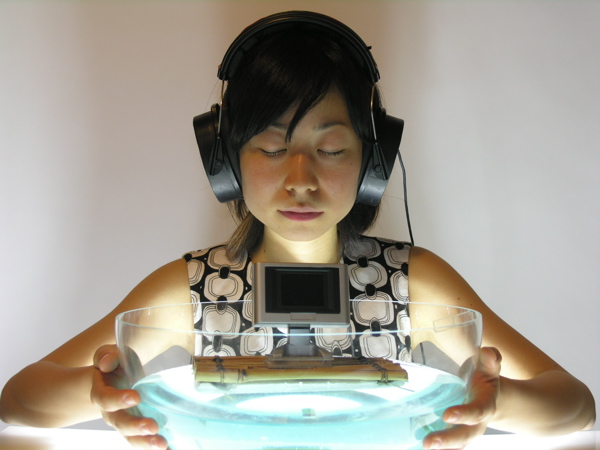
You start by using a digital camera to take a self-portrait and then loading to a compact display floating in a bowl of water. Now, all you have to do is put on a set of headphones with a built-in electrode, pick up the bowl of water, and the action gets underway. The motion of the water is transmitted directly to your body.

The compact display features an integrated acceleration sensor that measures shifts of the water surface and sends the data to the electrode in the headphones. It emits a low-voltage current that stimulates the portion of the inner ear that regulates the sense of balance.

A novel sensory interface based on galvanic vestibular stimulation (GVS) was developed for “SaveYourSelf!!!” Similar procedures are employed in medical tests investigating how well a person’s sense of balance functions. Even a very weak electric current (less than ~1.5mA) can disturb the feeling of equilibrium.

Rocking Power

A prenatal reaction to rock or sway is undoubtedly related to when a fetus is being carried in the womb and is subject to a gentle rocking motion that the mother is unaware of. Subconsciously, in times of high anxiety, it is possible for one to revert back to or rather mimic the sensation of being carried in the womb.

Rocking is therefore a universal soothing technique that spans across every culture. From being rocked as a baby and child, humans seem to never loose their sensitivity to rocking motion. Whether by the gentle lapping of waves on a boat, a swing in a playground, or hammock in the garden most people would be able to find relaxation and comfort.

The motion of rocking makes blood pressure fall and respiration slow. the physical act taps into a pleasure centre located in the brain that produces endorphins and thus creating a therapeutic affect. It is a self comforting system in which smooth, rhythmic changes in linear motion act as a natural stimulant to the central nervous system.

Interestingly rocking also helps stimulate our ability of balance, by activating the system within our inner ear. This also goes some way to help us be alert and attentive.

Spiritual Rocking
Most of the time we think of prayer as a static activity. Some orthodox jews use a rocking motion called ‘shukkeling’ when praying on the ha'shem. There are mixed explanations of this tradition; some believe that at the beginning of the production of scriptures there were few books for everyone to read so the rocking motion reflects an old custom of taking it in turns to look at the pages. Others might say that the motion of shukkeling is a way of enhancing concentration or that the words are igniting the soul like the lighting of a wick and so the body moves like a flame.

In some cases rocking is a proportional physical and spiritual response to prayer. Just as we might nod our head or tap our feet in time with a piece of music, some find that the saying of prayers stimulates a physical rocking motion.

The spiritual society of the ‘shakers’ has the most impressive rocking tradition. Rockers are part of all life stages - a craddle for the new born; a rocking horse toy; a rocking stool for work in the
household of the community; a rocking chair for leisure time, social meeting and reading of spiritual texts;an adult-size craddle for ill, weak or aged invalids. The gentle rocking movement helps to calm their spirit and prevent from bedsores. The rocking motion closes the circle of life,
from birth to death!

Designboom

Sensesweb
Vestibular Rehabilitation Therapy
Hair Cells in Balance

Tuesday, October 23, 2007

The World Turned Upside Down


Sensing what is up and down should be really straightforward. After all, it's such a vital thing to know. It guides how we walk, sit, stand, and tells us what things will fall over and where. But when you enter the old tilted shack on the side of a hill in Santa Cruz, California, your view of the world changes. Balls seem to roll uphill, a pendulum hangs off to one side, and people look like they're standing at impossible angles as if suspended by ropes.
...

Newscientist From issue 2169 of New Scientist magazine, 16 January 1999, page 37