The NASA Ames 5 degrees-of-freedom motion simulator. This simulator incorporated a centrifuge with a 30 foot spin radius. The simulated cockpit located within the hooded cab at the end of the centrifuge arm was driven by motors as required by the simulation about each of its three axes (pitch, roll, and yaw). The cab was also driven through a limited range of motion along the vertical axis and of course was driven by the centrifuge arm along a curved path of fixed radius in the horizontal plane. Thus the motions that could be simulated in the cab were three angular motions, one translational motion, and a curvilinear combination of the remaining two translational motions. The curvilinear motions and associated accelerations were of course, fairly representative of airplane flight. The simulator was placed in operation early in 1961.
Saturday, September 27, 2008
Ames 5 Degrees-of-Motion Simulator
The NASA Ames 5 degrees-of-freedom motion simulator. This simulator incorporated a centrifuge with a 30 foot spin radius. The simulated cockpit located within the hooded cab at the end of the centrifuge arm was driven by motors as required by the simulation about each of its three axes (pitch, roll, and yaw). The cab was also driven through a limited range of motion along the vertical axis and of course was driven by the centrifuge arm along a curved path of fixed radius in the horizontal plane. Thus the motions that could be simulated in the cab were three angular motions, one translational motion, and a curvilinear combination of the remaining two translational motions. The curvilinear motions and associated accelerations were of course, fairly representative of airplane flight. The simulator was placed in operation early in 1961.
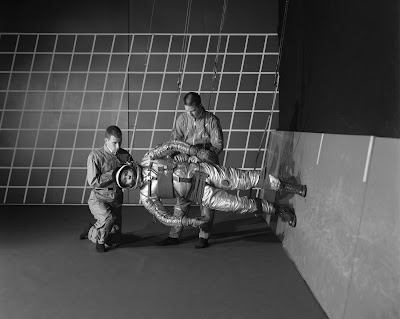
Reduced Gravity Walking Simulator
A test subject being suited up for studies on the Reduced Gravity Walking Simulator located in the hangar at Langley Research Center. The initial version of this simulator was located inside the hangar. Later a larger version would be located at the Lunar Landing Facility. This position meant that a person's legs experienced only one sixth of their weight, which was the equivalent of being on the lunar surface. The purpose of this simulator was to study the subject while walking, jumping or running. Researchers conducted studies of various factors such as fatigue limit, energy expenditure, and speed of locomotion.
FusionMan Makes Historic Jet-Propelled Flight

Following in the vapor trail of aviator Louis Bleriot, Yves Rossy made a historic flight of his own across the English Channel this morning. Yesterday (26th September 2008) Rossy—also known as FusionMan—became the first human to cross using jet propulsion.
Popsci
Anti-gravity Pen
Tuesday, September 23, 2008
Invention: Muscle-fatigue blocker
Fatigue occurs when muscles become weaker with repeated or intense exercise, or as a result of an illness.
Researchers have long thought that fatigue is caused by a build-up of lactic acid in the muscles, but in the past decade, a number of teams have shown that this process does not cause fatigue (and may in fact prevent it).
Muscle-fibre cells contract when calcium ions are released inside them, under the control of ion channels called ryanodine receptors.
Now, a growing body of evidence suggests that fatigue is actually related to how these calcium ions are released and processed. It seems that the ryanodine receptors can behave erratically after excessive exercise or due to disease, allowing calcium ions to leak out inappropriately and leading to fatigue.
So Andrew Marks at Columbia University, New York, has developed a drug that can switch those receptors back to their stable state, making it harder for fatigue to set in.
His invention may make it possible for athletes, soldiers, or anyone else doing strenuous exercise, to stave off muscle fatigue for longer.
Read the full muscle-fatigue blocker patent application.
Monday, September 22, 2008
Neutral Buoyancy
Working underwater closely simulates the weightless environment encountered by spacewalking astronauts. The underwater environment helps them learn how to position their bodies and how to maneuver themselves during an EVA, or spacewalk. Since they are actually in pressurized spacesuits, they also have an opportunity to evaluate reach, access and visibility to specific work areas.

